Bernard Damerval Seal
Bernard David Damerval

About
Who I am

My name is Bernard Damerval. I go to Highland Academy Charter School, where I am currently a Senior. For the past 4 years, I have participated in the TBA Theater youth academy programs, and in October 2018 I transitioned into the main company for public productions. My time in the theatre has given me confidence, and I am not afraid of public speaking. I joined theatre despite being somewhat socially awkward in part to address that problem, and it most certainly has. Doing a play puts a lot of pressure on a person, and as such I have also learned to stay calm under even significant pressure. I have found myself attracted to discussion as a source of learning and a chance to exercise my reasoning skills. My ability to analyze situations works well with my reasoning since it allows me to figure out what to do with my analysis.

However, my perception and analysis does lead to my most prominent fault: I am sometimes overwhelmed by it since it requires something to focus on to forget what’s going on around me. If too many things are going on, and especially if something has happened to stop me from focusing on anything like a headache, I am overwhelmed by the number of things assaulting my senses and can quickly become mildly irritable until given a moment to myself. During this time, I can also find it harder to reason because my head is swimming with countless things to interpret and think about. However, given a minute to collect myself, I can quickly overcome this and be back with improved performance, and if that minute is unavailable I still have enough theatre experience to put on a good face and enough patience not to escalate a situation with someone who might irk me.

Where I'm going

I hope to go to Hillsdale College, and find a school of Law while I am there that would be a good fit for me. My dream is to eventually become a contract lawyer, and as such I have planned to pursue a degree in philosophy during college because research shows that philosophy degrees are one of the better ways to prepare for Law school. I wish to be a lawyer because it’s a profession that allows me to feel helpful, since people need lawyers at some point in their lives and only lawyers can fill that particular role. In addition, law often involves discussion of some sort. If the plan with law does not work out, in some way or another, my alternative plans are to go to work in real estate or the culinary field, becoming a small business owner.

Work
Time Capsule Events
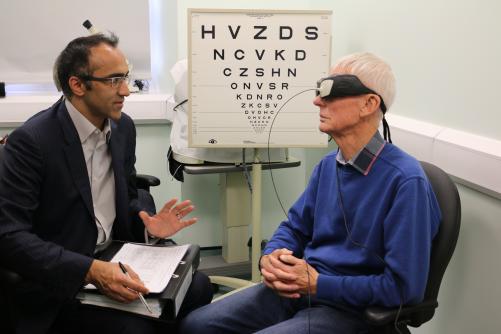
  • April 22, 2008: Surgeons at London’s Moorfields Eye Hospital perform the first bionic eye surgeries, implanting them into blind people
    Dr with patient
    In London’s Moorfields Eye Hospital, doctors implant a system that consists of a small, self-charging unit that powers a set of glasses. Those glasses have small cameras, made to look normal in public, that register images. Those images are then transmitted via connection to electrodes that are implanted in place of the retina which transmit electrical signals based off of the initial images to the optic nerve in such a way as the brain can register it as sight. It is very primitive compared to the complicated systems of our own eyes, but as more and more electrodes are fitted on, more and more detail can be seen. The sight that blind people derive from this reflects this primitivity, allowing people to see, discern objects, and get a sense of optical direction (a patient described one of the bigger boons of the device to be the ability to walk in a straight line in the middle of the sidewalk). Simple objects can be made out, but not in detail. However, it has made several people happy simply to be able to make out objects (such as their daughter dancing across a stage) without the need for the amazing detail our eyes give us.
    NHS Choices, NHS, www.moorfields.nhs.uk/news/nhs-england-fund-bionic-eye-surgery.
    NHS Choices, NHS, www.moorfields.nhs.uk/faq/bionic-eye-surgery-faqs.
    Sample, Ian, and Rachel Williams. “'Bionic' Eye Gives Blind People Some Sight.” The Guardian, Guardian News and Media, 22 Apr. 2008, www.theguardian.com/science/2008/apr/22/medicalresearch.news.s
  • June 11, 2009, Influenza strain H1N1 (swine flu) is labelled a global pandemic
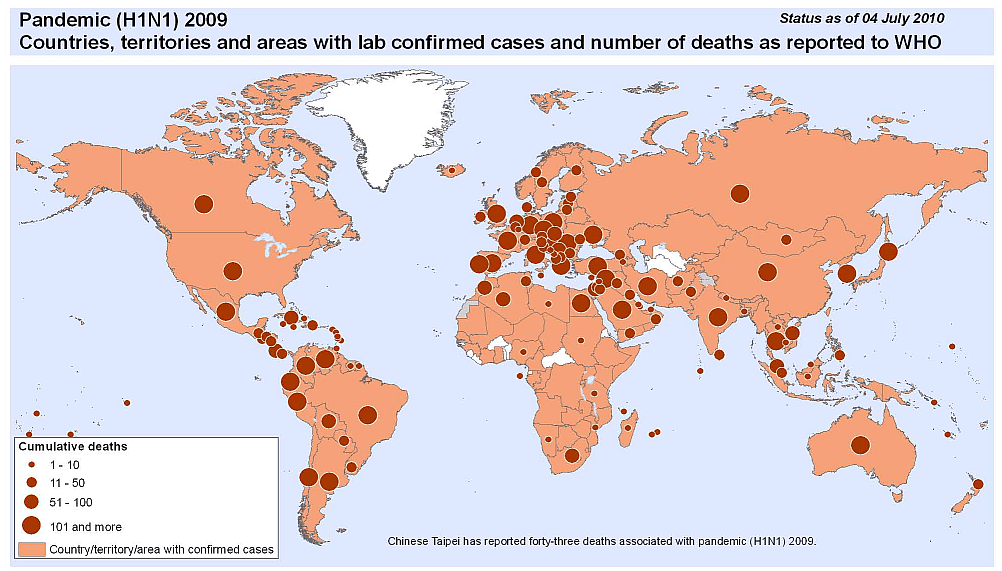
    The flu season of that year was particularly likely to spread and particularly deadly, being a direct descendant of the H1N1 Influenza, which was a virus that caused the Spanish Flu pandemic of 1918. As such, on June 11, 2009, the Flu of 2009 (called the Swine Flu due to it being transmitted initially from a strand that first evolved in pigs) was declared a global Pandemic. The WHO was later criticized of overdramatizing the event, and after research to see if they had, critics actually found that the WHO had under-dramatized it. The total death toll of the flu was around 284,000, which was much more than they had first thought. The flu had very typical symptoms, causing death through pneumonia or related effects on the lungs. Eventually, a vaccine was made and the flu disappeared before the end of 2010. However, the effect of it on the WHO and the public would be remembered enough for it to go down as one of the deadliest and most infamous flus in all of history, befitting for a direct descendant of the perpetrator of the single deadliest pandemic in the world. After the pandemic, the Anti-Vaxx movement responded, saying that once more vaccines had caused a Flu to spread. There is no evidence that the Swine Flu was caused by vaccines, and no evidence that vaccines cause disease. However, propagandizing the devaccination of the world will cause pandemics, and it is still a heated issue between people who don’t know what they’re talking about, but think they do, and people who know that they don’t know everything about what they’re talking about, but are discovering new things every day that lead to vaccines helping and not harming (which does seem a bit ridiculous, but duly reflects reality).
    Al-Muharrami, Zakariya. Sultan Qaboos University Medical Journal, Sultan Qaboos University Medical Journal, College of Medicine & Health Sciences, Aug. 2010, www.ncbi.nlm.nih.gov/pmc/articles/PMC3074714/.
    Bahar Gholipour. LIVESCIENCE, LiveScience Website, 26 November 2013, https://www.livescience.com/41539-2009-swine-flu-death-toll-higher.html
  • September 30, 2010, Germany finishes paying reparations for World War 1
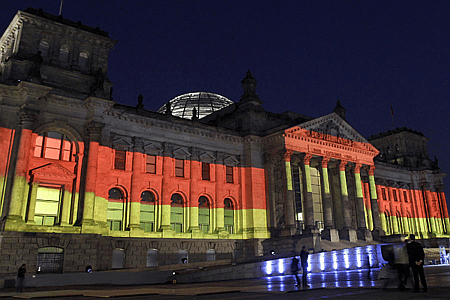
    At the close of WWI, there was an agreement signed called the Treaty of Versailles. This demanded that (in today’s dollars) twenty-two billion be paid to the Entente powers for the damages that Germany caused in the French countryside, to Britain, and to Russia. In June of 2010, they finally finished paying it off. They would have finished much sooner were it not for the fact that Hitler was notoriously opposed to paying the debt, and thus during his entire rule he stopped payments. The next Chancellor of Germany only resumed payment once East and West Germany were reunited. It was a momentous event for historians, who believe that it marks the true end of WWI. Most Germans didn’t celebrate the event, as Germany has put all that in the past and closed up the old wounds it sustained during that period of time. Most Germans don’t even know the Treaty of Versailles even existed. This is both a virtue and a shame. This way, it may at least help there not be an anti-world nationalist movement by the German public, but if they’re smarter than to make the same mistakes over and over again, then it’s a shame that such an important part of history is being lost by the country that it is most important to.
    “Germany Finishes Paying WWI Reparations, Ending Century of 'Guilt'.” The Christian Science Monitor, The Christian Science Monitor, 4 Oct. 2010, www.csmonitor.com/World/Europe/2010/1004/Germany-finishes-paying-WWI-reparations-ending-century-of-guilt.
  • January 4, 2011, The Arab Spring (and with it, the arab winter, which would come later as a result) begins
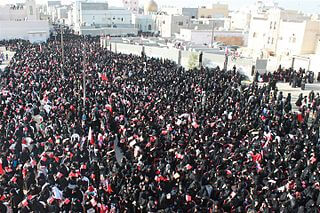
    A wave of anti-dictator protests sweeps the middle east. Dictators strike back, using a military to quell the violent uprisings, but more and more people begin to rise up against an oppressive government. This was the situation in 2011, when the Arab Spring began. As a result of its beginning, it would include a significant part of the Syrian Civil War, involve protests against terrorist-held cities’ government by the people, and even spark several other civil wars over the period of its life. The Arab Spring would eventually translate into the Arab Winter, due to the winter marking a time period of the same events where the situation has only grown worse, and just as one might begin to think things will get better, one government or the other launches a Sarin attack on protesters and it all explodes into movement again. ISIS and ISIL are also provoking attacks against governments by making moves that they can easily blame on governments, prompting the U.S. to attack several regions to get rid of ISIS, ISIL, or a supposedly brutal Middle Eastern dictator. To add to that, terrorist organizations all over the middle east are causing problems by attempting to invade countries that are being attacked, such as Syria.
    Staff, NPR. “The Arab Spring: A Year Of Revolution.” NPR, NPR, 17 Dec. 2011, www.npr.org/2011/12/17/143897126/the-arab-spring-a-year-of-revolution.
    “Timeline of the Arab Spring.” Wikipedia, Wikimedia Foundation, 18 Apr. 2018, en.wikipedia.org/wiki/Timeline_of_the_Arab_Spring.
  • March 15, 2011, The Syrian Civil War begins with protests of Bashir Al-Assad that lead to sieges of cities and arrests of protesters
    Capsule Event Picture Description
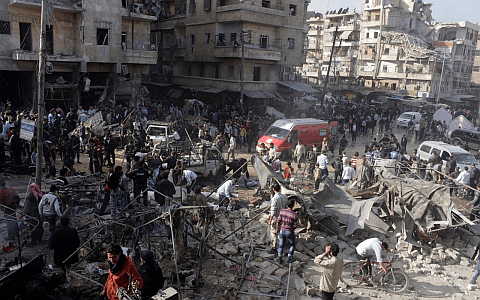
    Just as Bashir Al-Assad is confident that the wave of Civil War that has struck the middle east, unseating authoritarian rulers in Egypt and Tunisia, won’t strike his nation, a sudden burst of protests appear. These protests are violently responded to, and the violent response is violently responded to, and so on. This would cause Bashir Al-Assad to reconsider his position, and would cause terrorist organizations like ISIS and ISIL to exploit Syria’s weakness and attempt to invade. Currently there are several parts of Syria held by terrorist organizations, though none by ISIS or ISIL, and the pattern of violence continues. There have been several alleged attacks of chemical warfare from Assad to his people, which have violated the Geneva convention if these accounts are true. However, it is possible that ISIS or ISIL launched these attacks, and they have violated the Geneva Convention before. Regardless of who attacked with chemicals, chemical attacks did happen, and while many accounts of them are false there are several hospitals that have been bombed by Assad that contained people who were being treated for Chlorine and Sarin poisoning. The Geneva Convention is being violated to a certain degree due to the brutality of Assad’s methods against his non-supporting people and the terrorist organizations that are attempting to gain their first outright country, governed by them.
    Britannica, The Editors of Encyclopaedia. “Syrian Civil War.” Encyclopædia Britannica, Encyclopædia Britannica, Inc., 11 Apr. 2018, www.britannica.com/event/Syrian-Civil-War.
    “Syria: The Story of the Conflict.” BBC News, BBC, 11 Mar. 2016, www.bbc.com/news/world-middle-east-26116868.
  • November 14-21, 2012, Israel launches operation Pillar of Defense against the Palestinian Gaza Strip, Killing Hamas military chief Ahmed Jabari. In the following week 140 Palestinians and 5 israelis are killed in the ensuing cycle of violence
    Capsule Event Picture Description
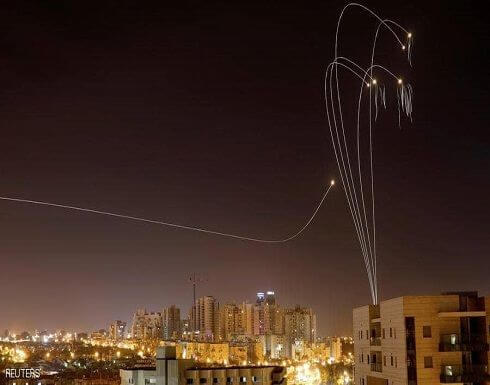
    After countless rockets are launched at Israel, the country believes that it has a right to self defense. It fights against Palestine, countless terror organizations, and Hamas, an organization based in Palestine that is determined to end Israel, and during the long war between the two Hamas acquired a leader: Ahmed Jabari. He was involved in countless terror attacks against Israel, including bombings and an attack against an Israeli school bus which killed 2 children. When he became the leader, Israel decided to attempt to organize a peace treaty and hope that Hamas would calm down and hopefully keep the Gaza strip, a hotly disputed territory, under control. Instead of this, shortly after negotiations, Jabari either ordered or permitted a barrage of rockets to be sent at Israel. Israel responded with military force in the form of Operation Pillar of Defense, which began with the assassination of Jabari. Afterward, rocket attacks continue undeterred, and Israel continues fighting in the Gaza Strip. 5 Israelis are killed during the following week, 140 Palestinians are killed, and 1500 terrorist sites in the Gaza strip, hundreds being underground rocket launchers and transportation tunnels alone, are targeted and destroyed by the Israeli military before Palestine finally relents and Operation Pillar of Defense ends.
    Embassies.gov.il, embassies.gov.il/new-york/NewsAndEvents/Pages/Summary-of-Operation-Pillar-of-Defense.aspx.
    “Israel's Wars & Operations.” Operation Pillar of Defense, www.jewishvirtuallibrary.org/operation-pillar-of-defense.
    “Operation Pillar of Defense (Gaza – November 2012): Objectives and Implications.” Jerusalem Center For Public Affairs, jcpa.org/article/operation-pillar-of-defense-gaza-november-2012-objectives-and-implications/
  • November 8, 2013, Typhoon Haiyan hits the Philippines and Vietnam, causing at least 6,241 dead
    Capsule Event Picture Description
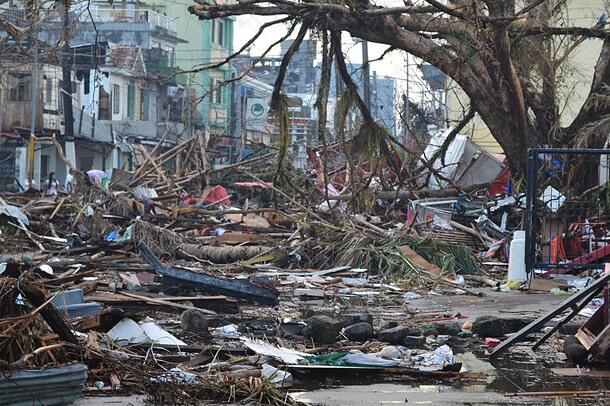
    Typhoon Haiyan was the most powerful typhoon ever to hit the Philippines, with sustained wind speeds of 195 mph, and gusts of 235 mph. It travelled across the philippines causing unequaled destruction and carnage, flattening several towns until there were only a few houses standing in each neighborhood. An estimated 6500 died, along with an additional 800 missing. It was tied with Typhoon Meranti in strength as the strongest windstorm ever by sustained wind speed until Hurricane Patricia, at 215 mph sustained wind speed. It hit first the Philippines, and then went on to hit Vietnam and finally dissipate over China. It was categorized as a Super Typhoon, the equivalent of a Category 5 Hurricane. It affected an estimated 11 million people, causing many homeless and injured. It was first detected on November 2 by the Joint Typhoon Warning Center (JTWC) which began monitoring a low-pressure area. The Japan Meteorological Agency classified it as a tropical depression the following day. At midnight of that night, November 4, it intensified quickly into a Tropical Storm and prompted the JMA to assign it the name Haiyan (Chinese for Petrel). On November 5, it intensified yet more with an embedded eye developing, and the JMA identified it as a typhoon later that day. The Philippine Atmospheric, Geophysical and Astronomical Services Administration (PAGASA) assigned it the name Yolanda once it passed into their area of responsibility. On November 7, it hit its peak, and just in time to hit the Philippines as well.
    “Super Typhoon Haiyan Surges Across the Philippines : Natural Hazards.” NASA, NASA, earthobservatory.nasa.gov/NaturalHazards/view.php?id=82348.
    “Typhoon Haiyan.” Wikipedia, Wikimedia Foundation, 29 Apr. 2018, en.wikipedia.org/wiki/Typhoon_Haiyan.
    “Typhoon Haiyan: Images of Then and Now.” BBC News, BBC, 6 Nov. 2014, www.bbc.com/news/world-asia-29931035.
  • February, 2014, Ebola virus strain of Viral Hemorrhagic Fever strikes West Africa, infecting at least 28,616 people and killing at least 11,310 people.
    Capsule Event Picture Description
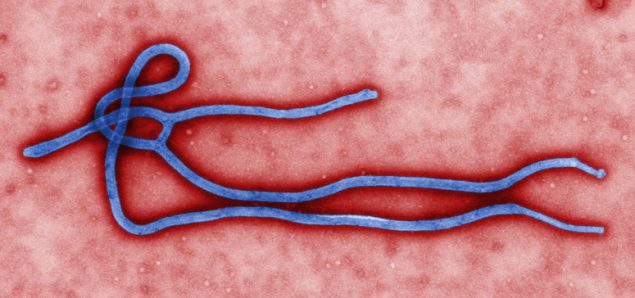
    In February, 2014, a two-year-old child eats soup with bat meat, a local delicacy in Guinea. However, unbeknownst to the child or their parents, the bat was contaminated with a strain of virus that causes Viral Hemorrhagic Fever, a disease caused by viruses, in this case the Ebola virus, which has effects wherein the infectee gains a bad fever and, if untreated, dies in 70% of cases by internal bleeding. The disease is characterized by the emerging of a fever before the major external symptom emerges: bleeding from every orifice. Their eyes, nose, ears, mouth, and every other entrance to the inside of their body begins flowing with blood. This characterizes Viral Hemorrhagic Fever. The child would later die, in march of 2014 shortly after hemorrhaging began, but not before spreading the disease through bodily fluids to a few others. As diseases go, Ebola is slow to spread, but a few months is more than enough to spread the disease to a few. Those few had a ballooning effect, spreading it to tens of thousands of others. The U.S. would send doctors to reduce the death rate, and occasionally those doctors or their nurses got infected. Only 2 U.S. citizens died of the disease, both of which caught it in Africa after it had spread to Guinea’s surrounding countries. However, the disease caused a huge scare in the U.S. as people and the media overdramatized it to be spread by air and to kill in a few minutes, instead of a few months. The outbreak would continue to 2016, where it would finally be eradicated through the use of vaccines and medications.
    “Ebola (Ebola Virus Disease).” Centers for Disease Control and Prevention, Centers for Disease Control and Prevention, 22 June 2016, www.cdc.gov/vhf/ebola/outbreaks/2014-west-africa/index.html.
    “West African Ebola Virus Epidemic.” Wikipedia, Wikimedia Foundation, 1 May 2018, en.wikipedia.org/wiki/West_African_Ebola_virus_epidemic.
  • June 30, 2015, Cuba becomes the first country in the world to eradicate mother-to-child transmission of HIV/AIDS
    Capsule Event Picture Description
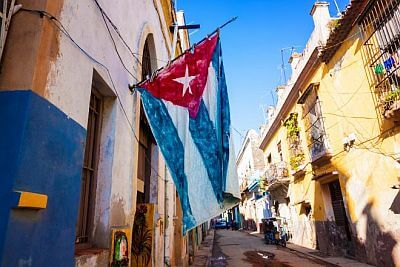
    In 2015, Cuba developed a series of antivirals that would be administered during various stages where transmission of HIV from the mother to the child. These stages are pregnancy, labor, birth, and breastfeeding. The WHO has validated that Cuba has properly eliminated mother-to-child transmission using this series of antivirals. This means that while other countries use antivirals that reduce the chance to 1%, from 25-40% at each stage, Cuba has reduced the chance to so low that it may as well be 0%. However, this breakthrough is even better than it seems. These antivirals also help to eliminate the chances of Congenital Syphilis to less than or equal to 50 cases per 100,000 people per year. While Cuba is the first country to have done this, and has a solid plan to eliminate Syphilis to 0 cases per year by 2021, there are many other countries with similar plans for HIV and Syphilis, meaning that perhaps this HIV pandemic is finally coming to an end. HIV has been around since the 80’s as a global pandemic, and has the effect of crippling the immune system. This makes it immune to being vaccinated against, as it targets the immune system and thus even weaker versions of the virus are fully capable of killing a person via secondary infection. People who have HIV are usually confined and regularly medicated. Those who catch it are likely to live the rest of their lives within a mile of a hospital, if not in the hospital itself.
    Ishikawa, Naoko, et al. Bulletin of the World Health Organization, World Health Organization, 1 Nov. 2016, www.ncbi.nlm.nih.gov/pmc/articles/PMC5096356/.
    “WHO Validates Elimination of Mother-to-Child Transmission of HIV and Syphilis in Cuba.” World Health Organization, World Health Organization, 2 July 2015, www.who.int/mediacentre/news/releases/2015/mtct-hiv-cuba/en/.
  • September 9, 2016, North Korea conducts its fifth and reportedly biggest nuclear test
    Capsule Event Picture Description
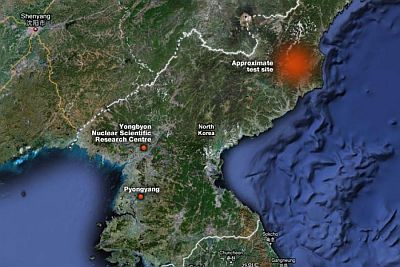
    On September 9, 2016, North Korean Dictator Kim Jong Un orders the launch of a nuclear ballistic missile, with outside estimates putting it at between 10 and 20 megatons of force (about as strong as the bomb that was dropped on Hiroshima). With the detonation of the missile, things spring into action. Due to the impact, tremors happen, both physically and politically. The political impact was addressed by the South Korean president, who said that it was a demonstration of the insane and reckless behavior of Kim Jong Un. Then-president Barack Obama threatened consequences if things like this continued. It was condemned by the entire U.N. and Japan also threatened to take action against this. There were debates over what would be done about North Korea should things like this continue, and it was clearly a threat to the rest of the world, at least in the eyes of the UN. However, it has partially led to a series of negotiations that have happened in recent times, shortly after the last event talked about in this short series, during which the Koreas have finally ended the Korean war and are talking about peace treaties and possible reunification.
    “North Korea Claims Success in Fifth Nuclear Test.” BBC News, BBC, 9 Sept. 2016, www.bbc.com/news/world-asia-37314927.
    “September 2016 North Korean Nuclear Test.” Wikipedia, Wikimedia Foundation, 30 Apr. 2018, en.wikipedia.org/wiki/September_2016_North_Korean_nuclear_test.
  • August 25-30, 2017, Hurricane Harvey strikes the United States as a Category 4 hurricane, causing 108 deaths and $125 billion in damage to the Houston Metropolitan Area
    Capsule Event Picture Description
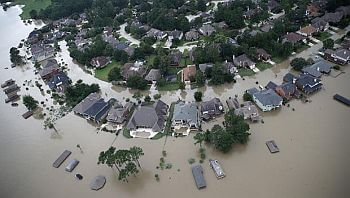
    In 2017, something began to stir in the atlantic ocean. Near Africa, heated air began to cause winds, sucking in clouds and spinning faster and faster as it moved across the Atlantic towards the United States. NASA tracked it, and eventually determined it to be a category 3 hurricane, dubbed “Harvey,” that was intensifying. Finally, it reached its peak at a category 4 soon before reaching San Jose island in Texas. Harvey caused catastrophic flooding and winds that ripped pieces off of buildings, and by the time it dissipated over Louisiana it had caused $25,000,000 in damages, being the costliest hurricane tied with Katrina. It was the first tropical hurricane in a record 14 years. There was much joking and discussion, when it hit, about how Texans were handling the situation with humour and stoicism as opposed to the Floridians who had experienced the equally-damaging Katrina years earlier and responded with pleas for help and a feeling of doom (according to the Texans).
    Jenner, Lynn. “New NASA Maps Show Flooding Changes In Aftermath of Hurricane Harvey.” NASA, NASA, 17 Aug. 2017, www.nasa.gov/feature/goddard/2017/harvey-atlantic-ocean.
    “Hurricane Harvey.” Wikipedia, Wikimedia Foundation, 3 May 2018, en.wikipedia.org/wiki/Hurricane_Harvey.
  • March 9, 2018, President of the United States Donald Trump accepts an invitation by the North Korean Dictator Kim Jong Un to discuss denuclearization of North Korea
    April 20, 2018, North Korean Dictator Kim Jong Un suspends nuclear tests in North Korea and closes the test site
    Capsule Event Picture Description
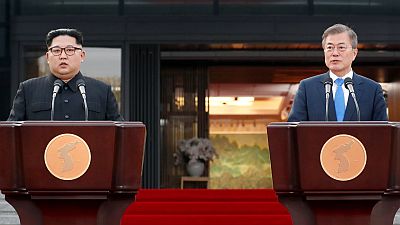
    In the early 1950’s, there was a civil war in Korea. Back then, it was one country, but between the north and the south there was a war and they became two. Ever since then, the Korean War has been at armistice. The border between the two countries, referred to as the Korean Demilitarized Zone, is the most militarized zone in the world. Over the last 70 years, the Communist North Korea has switched Supreme Leaders twice, starting with Kim il Sung, until his death and secession to Kim Jong il, and furthermore with Il's death and secession to Kim Jong Un, the current Supreme Leader. Un has advanced Korea’s nuclear armament significantly, but recently has decided to initiate peace between the two countries for the first time in over 70 years. The two leaders met on the border and walked across into each other’s countries, and put fertilizer and water from both countries into a pine tree that had been planted there. Un even admitted to having the inferior economic system, and understanding why there were people in the North that escaped to the South. Un also invited the President of the United States Donald Trump to a meeting to discuss the denuclearization, and the President of South Korea Moon Jae-In is scheduled to meet with Trump on May 22 to discuss the meeting about the denuclearization. This is a huge step in the direction of peace for the two countries, and a huge step in the direction of peace in general. As aforementioned in the topic, soon after the invitation to meet about the denuclearization Kim Jong Un decided to close down one of the nuclear test sites, suspending all tests to be done on that site, until future notice or an order to denuclearize.
    Campbell, Charlie. “North Korea: Why Denuclearization Is Still a Long Shot.” Time, Time, 30 Apr. 2018, time.com/5259353/north-korean-kim-jong-un-denuclearization-long-shot/.
    Fifield, Anna. “In a Feel-Good Korea Summit, Kim Lays the Groundwork for Meeting with Trump.” The Washington Post, WP Company, 27 Apr. 2018, www.washingtonpost.com/world/asia_pacific/north-and-south-korea-agree-to-work-toward-common-goal-of-denuclearization/2018/04/27/7dcb03d6-4981-11e8-8082-105a446d19b8_story.html?noredirect=on&utm_term=.db9c739f8a0f.
    “Kim Jong Un Pledges 'No More War,' Denuclearization at Historic Summit.” NBCNews.com, NBCUniversal News Group, www.nbcnews.com/news/world/north-korea-s-kim-jong-un-crosses-border-historic-talks-n869276.
    Moore, Mark. “North Korea Warns US against Taking Credit for Denuclearization.” New York Post, New York Post, 6 May 2018, nypost.com/2018/05/06/north-korea-warns-us-against-taking-credit-for-historic-reconciliation/.
The Effect of Authoritarian News

The press has always held a lot of power in human society, and in all likelihood it always will. Our inherent inability to witness every single relevant event in our communities, small and large, leads to our dependence on a system for spreading important news through oral, written and, within the last century, audiovisual media. Within these media outlets, no matter their actual credibility, is the potential to sway the opinions of many. Furthermore, if all news outlets begin to say the same thing, a majority of people in the nation will end up believing the same thing. This is unavoidable even in a world where the free press makes up the vast majority of reliable sources: even free, it tends to report only the juiciest facts, those that people are willing to pay to hear.

However, what should be avoided at all costs is government control over the press. In nations where the press is controlled by an overarching government, that government has power over what people believe. The problem with this is it gives the government absolute power, and absolute power corrupts absolutely.
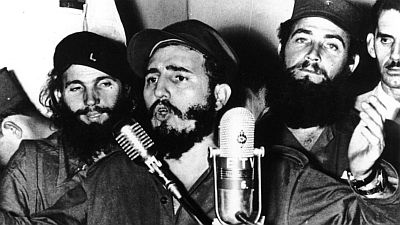
Though they remain a minority, there are increasing numbers of people who think that non-democratic military rule would not necessarily be a bad thing. In 1995, 1 in 16 people favored a military dictatorship government in the United States. Today, that ratio has more than doubled to 1 person in 6. Lest we forget, the clear and shocking problem with this is evidenced by the events in Cuba during the Communist revolution brought about by Fidel Castro. One of Castro and Guevara’s consistent missions was to get the people to adore them, and because of this most people in Cuba either remained oblivious to the large number of dead “political dissidents” or believed those deaths righteous, thinking that Castro and Guevara could not possibly be wrong. This example demonstrates with striking clarity that shirking our individual responsibility and letting a small group of people have free rein over the information disseminated in our society is a terrible idea.

We want for proof the proverb quoted earlier : Absolute power corrupts absolutely. Asserting that all the responsibility belongs to one power, say a congress of sorts, means that that congress gets all the power. They gain the ability to make all the decisions - when you get a job, when you have kids, what information you should be looking at, and so on. Because of this, they become corrupt, and begin making decisions of self-interest as opposed to public interest. The people end up miserable, but unable to do anything except hope that a violent revolution will resolve the crisis. The power is in the hands of the people, always, but that doesn’t mean the people don’t have to fight to reclaim that power on occasion.
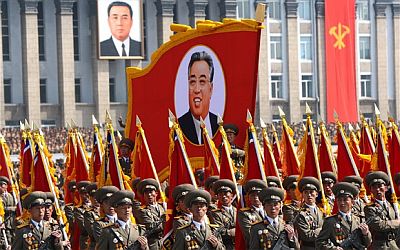
Nortk Korea celebrates birthday of Kim Il Sung

Nor is such abuse confined to the annals of history. North Korea provides us with a chilling demonstration of the inherent evil that lay in falsifying the news through propaganda to serve the interests of a totalitarian government. When sources are controlled, the only news people hear is that which agrees with the government, and when the only information available presents facts in a certain light, people have no choice but to believe that specific set of facts. The ability of a government to control information ends up granting that government the ability to control the populace. If the populace believes every decision you make will be good, the chance of violent revolution from a people leading a miserable life grows more remote because they either no longer believe their lives will be permanently miserable, or they believe that they’re really not that miserable, at least not compared to the other nations of the world. If a government can convince people that they are not starving as much as the rest of the world, these people become happier than they should be with what the government is unjustly giving them. They end up allowing the powers that be to drive the entire country to the brink of destruction before they are able to do anything about it.

History, both ancient and modern, therefore shows us that it is folly to let the spread of information end up in the hands of authority; that the only authority allowed over media outlets should be, for better or for worse, the people themselves. They also show us that a free press engaged in a healthy critique of authority is necessary in order to keep said authority engaged in what should remain its primary mission - serving the people who elected it into existence. Accountability is the only check we can place on power. Free media are the only means to implement that accountability on behalf of the people. No healthy society or country can survive long without it.

United States Holocaust Memorial Museum, United States Holocaust Memorial Museum, encyclopedia.ushmm.org/content/en/article/nazi-propaganda-and-censorship.
United States Holocaust Memorial Museum, United States Holocaust Memorial Museum, encyclopedia.ushmm.org/content/en/article/third-reich-an-overview.
CBS News. “Harvard Researcher's Startling Findings: Young People Open to Military Rule.” CBS News, CBS Interactive, 30 Nov. 2016, www.cbsnews.com/news/harvard-researchers-startling-findings-young-people-open-to-military-rule/.
Depalma, Anthony. “Fidel Castro, Cuban Revolutionary Who Defied U.S., Dies at 90.” The New York Times, The New York Times, 26 Nov. 2016, www.nytimes.com/2016/11/26/world/americas/fidel-castro-dies.html.
“Fidel Castro.” Wikipedia, Wikimedia Foundation, 30 Apr. 2020, en.wikipedia.org/wiki/Fidel_Castro.
Sullivan, Kevin, and J.Y. Smith. “Fidel Castro, Revolutionary Leader Who Remade Cuba as a Socialist State, Dies at 90.” The Washington Post, WP Company, 26 Nov. 2016, www.washingtonpost.com/world/fidel-castro-cuban-dictator-dies-at-90/2016/11/26/f37bf3bc-b399-11e6-be1c-8cec35b1ad25_story.html.
The Editors of Encyclopaedia Britannica. “Fidel Castro.” Encyclopædia Britannica, Encyclopædia Britannica, Inc., 4 Feb. 2020, www.britannica.com/biography/Fidel-Castro.
Historically Modern Conflict

History repeats itself. We all know and repeat this phrase time and time again. It is an observable fact of life. Many events, such as the rejection of new ideas like the existence of bacteria and the earth’s orbit, happened very separately but the reaction from the people was much the same. Another case of this is the World War II Operation Barbarossa, where Hitler attempted to invade the Soviet Union, and Napoleon’s attempts to invade russia, both failing for having arrived during Rasputitsa (Mud season), or simply Autumn in russia, where the air gets cold and autumnal rains fill the ground with mud that soldiers, horses, and tanks alike sink into.
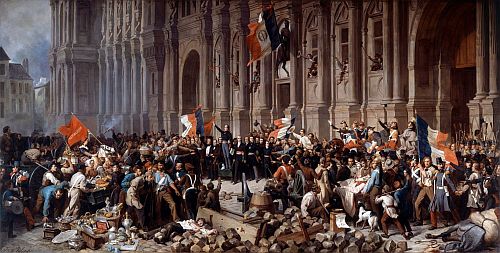
1848 French Revolution

The cyclical nature of human history is again demonstrated in the situation of the Arab Winter, an event of the modern day in which many arabian countries are rebelling against their tyrannical governments. The arab winter is thus, observably, a modern-day repeat of the 1848 European Revolutionary Period. People have always been in a cycle of dictatorship and revolution, as dictators arise from an excess of power and the people rebel against a tyrannical descendant of that dictator. Kings and queens arise in the same way, and the people rebel against them too, eventually. The people see kings and queens as glorified dictators, and dictators as renamed kings and queens. The 1848 European Revolutionary Period is an event in which the people rebelled against their kings, and the Arab Winter is an event in which people are rebelling against tyrants like Assad and political groups attempting to gain power.

A dictatorship or monarchy disregards the nature of man - freedom - in all but the case of the leaders, who abuse their freedom to the extreme in some cases and in others use it to massive benefit. Either way, power is in the hands of one major figure, and that does not suit the nature of man well. To see this, one must simply see the numerous but not completely counted number of rebellions against dictators or monarchs that have existed in the past, and exist in present. One might also see the wars waged against organizations that are bent on ruling the world under a certain set of rules, such as ISIL/ISIS, which intend to impose Sharia law upon many people whether they like it or not. There is an active war against these organizations by many countries in the world, even including Turkey, which is a mostly muslim country. These wars happen because it is the nature of man to be free.
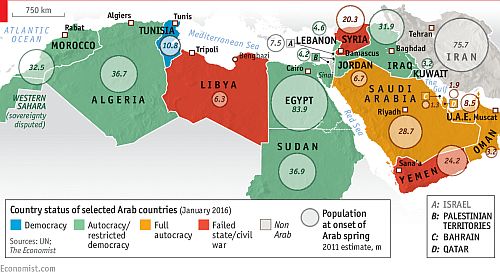
If one were to take a good look at the Arab Winter and The 1848 Revolutions, there would be several similarities to plainly see. One such is the obvious; they are both multiple revolutions against governments by their people. The 1848 Revolutions addressed the presence of monarchs without the presence of a group that represented what the people actually wanted. Only in the cases of Denmark and France did it work, with the government and people quickly coming to a peaceful conclusion - in Denmark, because the reduced population and civic spirit allowed a consensus to arise, and in France, because the violence and horrors of the revolution were already behind them at that point - 1848 actually marked a brief return to royalty there, ending in 1852 to mostly unanimous conclusion. In the other european countries of the time, such as the Empire of Austria and the Kingdom of Prussia, the revolutions were violently quelled, with citizens being shot ruthlessly. In countries such as the United Kingdom (of ireland and great britain) the revolution simply didn’t manifest with the intensity required to provoke any governmental response. In a similar way, the Arab Winter is proving to be a revolution that provokes various reactions from governmental entities. The most famous example of this is the fact that Assad, current dictator of Syria, is slaughtering opponents and innocents alike, whether they spoke against him in the past or never said a word. The spillover of the Syrian Civil war is causing some degree of uproar in the Islamic world, and currently there are many North African countries such as Egypt that are experiencing a similar kind of trouble, though not to the same degree.

On the other hand, the presences of ISIS and ISIL are a major difference from the 1848 Revolutions. The 1848 Revolutions had no such outside international entity, and as such the governments were inclined simply to put down the people and be done with it. In the case of the Arab Winter, the government has to juggle dealing with the War on Terror and the domestic factions causing trouble within the country. ISIL bombed Turkey several times, and Turkey has since dragged the United States into the war. Turkey is one of the few Muslim-based countries to not be very affected by the Syrian Civil War internally, instead being able to focus entirely on quelling the influence of ISIL and ISIS in the Arab Winter, and the Middle East in general.
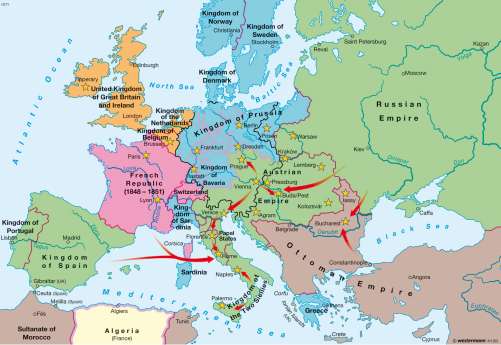
Both events, however, seem to be fairly localized. The middle east and europe, while both large, are separated in time and space, and neither revolution is relevant to the other. During the 1848 Revolutionary Period, the Ottomans had every opportunity to interfere with the revolutions in some way or another, and yet they didn’t. The closest any of the european powers got to calling for foreign aid was Austria calling for the help of the Polish in ending their rather violent rebellion. In just the same way, none of the Middle Eastern countries that are dealing with civil war have called upon foreign aid. Turkey called upon the US to help with the destruction of ISIL, and the US was already fighting ISIS, but Turkey is not dealing with civil war. Those countries that are dealing with civil war may not be asking for aid from the US for several reasons, including avoiding giving the appearance of siding with the United States.. One well-documented case of this is Assad, who appears to have established himself as the hate-figure of the entire United Nations, not to mention the United States.

This notwithstanding, the Arab Winter is also sometimes called the Syrian Civil War Spillover, due to it stemming from the Syrian Civil War. When one uses the term Arab Winter, they are talking about the events as a whole, however these are technically two separate events. The Syrian Civil War sparked a continually burning flame that manifests as the Arab Winter. On the other hand, the 1848 Revolutions started independently, though perhaps sparked on in some way by the french revolution 40 years earlier. However, they did not happen as a result of the French 1848 revolution, as that one was the fourth to happen in that group. We can thus observe that while the former appears to be a rapid succession of similar uproar taking place in rapid succession, the latter may be viewed as the result of a single uproar which had taken place some decades earlier.
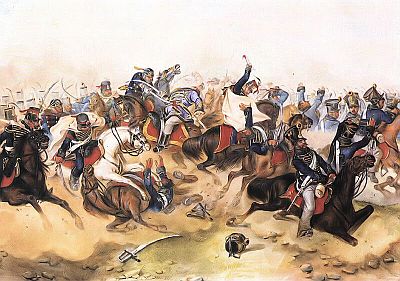
The severity of the uproar in question is a similarity between the two events, as well. Demonstrations in the current middle east can range from peaceful protests to violent riots. Peaceful protests are often the result of people with high “thresholds” all gathering together in protest, without any of them daring to engage in acts of violence. Despite this, in some cases the military will still act violently in return, causing many deaths among the unsuspecting and non-retaliatory masses. In the 1848 Revolutions, the people also had many different kinds of demonstration, though in that time it was perhaps more common for them to execute people who were still loyal to the king and to drag nobles from their houses to be massacred by the dozens. There were some people in 1848 who held up signs in protest to government, and many other people who held up pitchforks and torches. The military reaction was even much the same, with peaceful and violent protests being taken down by force just as frequently as they are in the Arab Winter.

The final difference to make is with regards to technology and thus in the severity of the military response. For instance, in 1848 cannons would be fired at the crowd in an attempt to scare and/or kill protesters. This, while impactful for the time, does not compare to the horror caused when Assad’s military had rows upon rows of tanks roll into neighborhoods and shell them, killing thousands of innocents and protesters alike, during the Siege of Homs. In a similar way, muskets being fired in a line at a protesting group that may or may not have muskets themselves would lead to a more balanced conflict, while military grade automatic weapons and explosives unilaterally overwhelm even the most creative of violent protesters, coming up with homemade explosives and illegal weaponry. Bomb cars and suicide bombers cannot even begin to match the destruction caused when a city is carpet-bombed.

The severity of the 1848 military response was certainly plenty, enough to make all rebellions that warranted military intervention fail, however it remains a mystery to me as to how they were defeated so much faster than the Arab Winter. Perhaps it has to do with population, or the determination of the people involved. Perhaps firepower may not be as decisive as collective spirit when it comes to human conflict - the populations in 1848 were grappling with concepts that were fairly new, while today’s Arab populations live in countries where domestic Law and customs are increasingly at odds with the unavoidable feed of globalized communications showing them that different principles can thrive and endure. It may be no coincidence that before the change of power in Egypt in recent years, one of the tactics used by the conservative government was to cut off the internet to all its citizens.
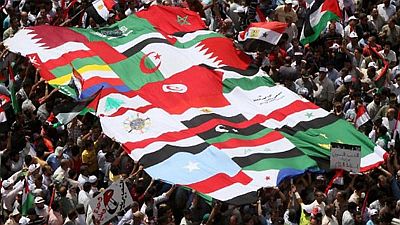
When we compare the details of both series of events, we see that while both the 1848 revolution and the Arab Winter feature large scale internal conflicts, the latter is more global in scope, with interventions from multiple external powers in support of their own interests. The 1848 rebellions were just that, a group of rebellions, while the Arab Winter has evolved into a full-scale war between Assad and his people, Turkey and ISIL, and between the US and ISIS. It has become a matter that, if the UN were any more inclined to do things, would be at the top of their to-fix list.

However, discounting the wars on terror organizations, it becomes clear that these are entire cultures that rise up, not just individual groups of people. Many people had a similar or identical government to those found in europe at the time, however they did not have similar rebellions in that time frame. It was, for the most part, culturally Christian people who caused these rebellions. Christianity, after all, is a religion promoting freedom and respect for all, provided you hold the mainstream view of the Testaments. There were also Christian church radicals on the other side, and corrupt clergy all round, just as there seem to be many corrupt Islamic leaders who use Sharia law to seize control over others.
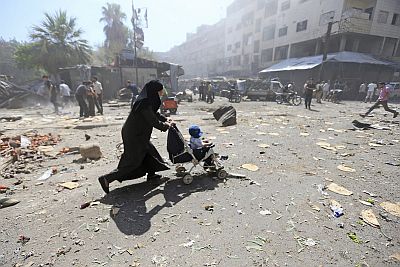
While demonstrations remained unpredictable and random, predicated as they were on the vagaries of daily life mingled with political strife, the military response did the exact opposite, staying rather consistent with its violent retaliations to peaceful and violent protests. There are, as in all things, some outliers, but they appear to be the exceptions that prove the rule. In this way, both seem to have gone in a similar way when it comes to the actions taken for and against the people. However, the keyword there is “similar” because the military reaction is so much more violent and destructive in the modern day that its impact cannot be reasonably compared to that of the 1848 militaries. However, it is a strange situation, since the 1848 revolutions seem to have had so much more effect on the populations that they affected, having rebellions only go on for a few weeks or months at a time, compared to the last seven years of the Arab Winter. Perhaps there is a connection between the level of atrocity and the severity of people’s reactions, causing a certain level to quell an uprising and anything above or below that to only feed it.

These two events complement each other. From researching one, information can readily be gleaned about the other. Each makes the other stand out, and yet somehow goes eerily with the other, like shadows reminiscent of multiple casting sources. Their similarities allow for a level of depth in one’s research that comes from viewing two related aspects of the same topic, which is what makes this one so interesting, as they appear to be from almost completely different topics.


"The Arab Winter." The Economist. The Economist Newspaper, 09 Jan. 2016. Web.
Byman, Daniel L. "After the Hope of the Arab Spring, the Chill of an Arab Winter." Brookings. Brookings, 28 July 2016. Web.
Gourevitch, Philip. "The Arab Winter." The New Yorker. The New Yorker, 18 June 2017. Web.
Spencer, Richard. "Middle East Review of 2012: The Arab Winter." The Telegraph. Telegraph Media Group, 31 Dec. 2012. Web.
"Siege of Homs." Wikipedia. Wikimedia Foundation, 25 Feb. 2018. Web.
"Spillover of the Syrian Civil War." Wikipedia. Wikimedia Foundation, 26 Feb. 2018. Web.
Wagner, Daniel. "The Death of the Arab Spring." The Huffington Post. TheHuffingtonPost.com, 16 Aug. 2013. Web.
"Revolutions of 1848." Wikipedia. Wikimedia Foundation, 25 Feb. 2018. Web.
The Editors of Encyclopædia Britannica. "Revolutions of 1848." Encyclopædia Britannica. Encyclopædia Britannica, Inc., 27 Dec. 2017. Web.
Hill, Jonathan Richard, "The Revolutions of 1848 in Germany, Italy, and France" (2005). Senior Honors Theses. 45.
Contact
Contact Me
Drop me a line...
7800 Snow View Dr.
Anchorage, AK 99507
16419 Marcus St.
Eagle River, AK 99577
(907) 854-9349
Causes
Causes I like to support

Below are a few organizations I like to support, either by donating, volunteering, or promoting them on social media with my friends and colleagues.


Anchorage Youth Courts www.anchorageyouthcourt.org
Alaska Peace Officers Association www.apoaonline.org/
Faternal Order Of Alaska State Troopers www.foast.org
Highland Academy Charter School PTSO www.phoenixes.org
Hillsdale College www.hillsdale.edu
TBA Theatre www.tbatheatre.org/
Cyrano's theatre company www.cyranos.org/
Perseverance Theatre www.ptalaska.org//
Scared Scriptless Improv www.facebook.com/ScaredScriptlessAlaska/
The Bill and Melinda Gates Foundation www.gatesfoundation.org
Médecins Sans Frontières (Doctors without borders) www.msf.org/
St. Jude Children's Hospital www.stjude.org//
The Surgery Center of Oklahoma surgerycenterok.com
The Humane Society of The United States www.humanesociety.org
The Alaska Sealife Center www.alaskasealife.org
The Georgia Aquarium www.georgiaaquarium.org
The Salvation Army www.salvationarmyusa.org
The Red Cross www.redcross.org
Alaska Public Media www.alaskapublic.org
Languages
Languages Spoken

I was fortunate enough to be born to a bilingual family. I was thus bilingual at an early age, and learning new languages was not as much of a challenge for me as it might otherwise have been. It is still a short list with some weak elements, but with time I hope to add to it and strengthen the ranks.

US Flag English C2 I was born in Alaska, and US English is my native language on my mother's side. I learned to read and write in it, used it at school and at home all my life, and it is the language I am most comfortable expressing myself in.

French flag French C1 My father emigrated to the US from France, and almost always spoke French to me as I was growing up. So did my grandparents - my grandfather, who has since passed away, and my grandmother, who is still with us. I still speak it with her and my father. Reading and writing in it is more of a challenge, but I am fluent in speaking and understanding it.

Italian flag Italian A2 I spent 6 months learning Italian to prepare for my trip to Italy in 2019. I do not speak or understand it fluently but know enough to get by, and it served me well while I was there.

German flag German A1 I took a semester of German during my sophomore year at Highland. The class was being assisted by a native student speaker. I look forward to brushing up my notions and one day visiting Germany and Austria.

Polish Flag Polish A1 I have been learning Polish through self-study ever since I represented Poland at the Model UN conference in Anchorage, in 2018. I was fascinated by Poland and the Polish culture as a result, both the people and the remarkable economic revival of Poland in the last couple of decades. I decided to learn the language in order to visit Poland one day. Progress is slow because it is a complex language but I am not giving up!